
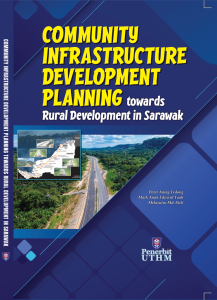
Community Infrastructure Development Planning towards Rural Development in Sarawak
Keywords:
Rural infrastructure, Sarawak planning, governance, stakeholder engagementSynopsis
The development of community infrastructure is essential for a region and its community’s socio-economic growth. This book adopts the qualitative approach by case study design with Song District, Sarawak as the study area, involving methods that included in-depth interviews with multiple key actors in the government and communities and direct observation to examine the community infrastructure planning in Sarawak. Based on a study carried out in Song District, Sarawak, the book findings shows that although there has been progress in the district’s development of community infrastructure, there were a number of challenges to delivering community to certain locations within the district, in addition to satisfying the community needs. The book reveals several challenges of the community infrastructure planning process namely influence of geographical factor, management of financial resources, cooperation and collaboration of stakeholders and community involvement. In terms of governance, the study highlights that governments at all levels needs to be aware of their responsibilities, utilising networks and collaborations with other agencies and community to enhance local decision-making in developing community infrastructure in rural areas. In sum, the book suggests that the presence of strong institutional actors and coordination involving government at all levels and community is important in dealing with the many challenges and governing a successful community infrastructure delivery to fulfill the needs of the rural community. Consequently, this book also recommended some improvements on the approach and mechanisms governing the rural community infrastructure planning in Sarawak.
Downloads
Download data is not yet available.
References
Abdullah, R. G. (2016). Accessibility and Development in Rural Sarawak. A Case Study of the Baleh River Basin, Kapit District, Sarawak,
Malaysia. (Doctoral dessertation). Victoria University of Wellington, New Zealand.
Abdullah, R. G. (2017). Accessibility and Development: A case study from rural Sarawak, Malaysia. International Journal of Business
and Society, 18(4), 791-799. Accordino, J. (2019). Introduction to Bridging the “Urban–Rural Divide”. State and Local Government Review, 51(4), 217-222.
Adu-Boahen, K., Mensah, E. A., Antwi, K. B., Atampugre, G., Osman, A., Osei, K. N., & Adu-Boahen, A. O. (2014). Role of rural infrastructural development in alleviating poverty in Ghana: A case of Jukwa, Central Region. International Journal of Development
and Sustainability, 3(4), 737-748.
Ahmed, S., & Eklund, E. (2019). Rural Accessibility, Rural Development, and Natural Disasters in Bangladesh. Journal of Developing Societies, 35(3), 391-411.
Akkila, I. (2013). The Relevance of Actor-Network Theory for Studying Urban Processes. Paper presented at the ATUT Conference Proceedings, Tampere, Finland.
Downloads
Published
1 March 2024
Categories
Copyright (c) 2024 Penerbit UTHM
Details about this monograph
ISBN-13 (15)
978-629-490-013-4
Physical Dimensions
How to Cite
Peter Aning Tedong, Mark Anak Edward Tuah, & Melasutra Md. Dali. (2024). Community Infrastructure Development Planning towards Rural Development in Sarawak. Penerbit UTHM. https://penerbit.uthm.edu.my/omp/index.php/penerbituthm/catalog/book/573